
“Blind reliance on AI…may constitute unreasonable reliance” under Circular 230, the standards for tax practice before the Internal Revenue Service.
Recently, the IRS Office of Professional Responsibility issued Guidelines for Responsible AI Use in Federal Tax Practice (IRS OPR Issue No. 2026-19). The overarching message is that tax professionals using AI must carefully review and verify all work using generative AI, must supervise staff using AI, and must safeguard information used in AI systems. The guidelines recognize that AI is a beneficial tool to be used with judgment, that it must be verified, and that practitioners should obtain continuing education as legal and professional guidance evolves. 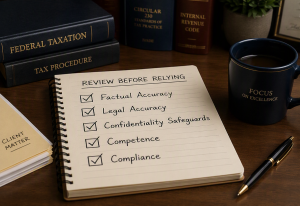
The guidelines include specific references to the standards of practice before the IRS in Circular 230, discussed below.
- Due diligence. Circular 230 § 10:22 requires practitioners to exercise due diligence in preparing tax returns and papers prepared for the IRS.
- All facts and law (including AI-generated content) must be verified before providing a product to a client or to the IRS.
- Fees. Circular 230 § 10:27(a) prohibits a practitioner from charging an unconscionable fee in connection with a matter before the IRS.
- AI use should be disclosed, and cost savings from AI should be passed along to clients through billing practices that reflect those efficiencies.
- Competence. Circular 230 § 10.35. A practitioner must be competent to practice before the IRS, which means the practitioner possesses the requisite knowledge, skill, thoroughness, and preparation necessary for the matter.
- A practitioner using AI must understand how AI develops content and recognize the potential for bias and errors.
- Compliance procedures. Circular 230 § 10.36. Practitioners and supervisors must take reasonable steps to ensure that the firm has adequate procedures for complying with Circular 230. This requires (i) establishing procedures, (ii) monitoring compliance with procedures, and (iii) acting promptly when procedures are not followed.
- Staff must be trained on AI use.
- Protocols must be established regarding handling data.
- Third-party tools must be vetted.
- Written advice. Circular 230 § 10.37. Written advice must be based on reasonable factual and legal assumptions. A practitioner is required to use reasonable efforts to identify relevant facts and not to rely on unreasonable representations.
- Practitioners must verify AI-generated content by checking citations, reviewing cited authorities, and confirming financial forecasts, inputs, and formulas. When AI’s underlying logic or services are unclear, reliance may be unreasonable.
- “Blind reliance on AI yields…may constitute unreasonable reliance.”
- Treat AI advice as a starting point, subject to thorough review before providing it to clients.
- Unauthorized disclosure. I.R.C. §§ 6713 and 7216(a) and Circular 230 § 10.51(a)(15). Civil and criminal penalties apply for unauthorized use or disclosure of tax return information. Under Circular 230, willful disclosure of tax return information is incompetent and disreputable conduct.
- Uploading client data to unsecured or public systems may disclose sensitive taxpayer information. AI should be used only with appropriate confidentiality safeguards.
In concluding, the IRS Office of Professional Responsibility reminds practitioners that the duties of competence, diligence, and confidentiality remain regardless of the means by which a practitioner conducts his or her tax practice. The alert concludes with the best practices below.
- Stay current with guidance pertaining to your professional activities.
- Establish protocols to secure data, including procedures for data access.
- Document who is using AI and how it is verified.
- Create AI practices that are transparent and accountable and that contain procedures for AI data breaches and citation errors.
- Train staff on appropriate use of AI.
- Before buying a third-party AI platform, vet it (including for data privacy).
- Never upload sensitive data to unsecured sites.
- Treat AI-generated text as a draft.
- Review the resulting documents for factual and legal accuracy and potential bias.
Treasury’s proposed regulations to update Circular 230 (REG-116610-20) do not specifically reference AI. Whether the project will be halted or amended to incorporate AI provisions remains to be seen.
June 30, 2026. Written by Kim Tyson.
* * * * *
This alert should not be construed as legal advice, does not create an attorney-client relationship, and reflects the state of the law as of the date on this notice. Subsequent developments in the law can affect the conclusions in this alert.
Read our related blog post:
The Playbook for Moving on from Citing Nonexistent Cases Hallucinated by AI