
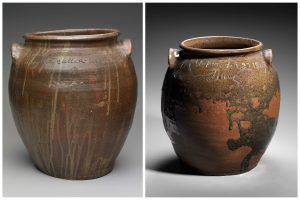
David Drake’s “Poem Jar” and “Signed Jar.” Photo courtesy of MFA, Boston. Andrea Shea, MFA resolves ownership for vessels by enslaved potter David Drake, WBUR (Oct. 29, 2025).
What is the Tax Basis of Artwork Transferred by a Museum to an Artist’s Descendants?
Before the Civil War, a slave named Dave was a potter in South Carolina. He became known as Dave the Potter, Dave the Slave, and, after he adopted the surname of his first enslaver, David Drake.
Dave created monumental stoneware vessels for food storage. The vessels included inscriptions (he could both read and write) with his name and date and with poignant and personal verses and poems. In recent years, his works have commanded very high prices on the art market, and some top art museums have been collecting his works. The Museum of Fine Arts, Boston (MFA) held two of Dave’s pieces: “Signed Jar” and “Poem Jar.”
The purchase and display of Dave’s work raised questions at the MFA of rightful ownership and whether Dave’s family should be benefitting from the rise of his fame in the art world. Victoria (Torie) Reed, the Provenance Curator at the MFA Boston, noted that Dave’s prized work was more than the creation of a commodity by an enslaved person at the behest of his enslaver.
As a legal matter, the MFA lawfully possessed the pieces, but the museum’s view was that the public interest is not served if the MFA, a public institution, is holding artwork whose creator was not remunerated and lacked the agency to decide whether to sell the pieces and for how much.
In October, the museum announced that it transferred ownership of Signed Jar and Poem Jar to a trust for the benefit of Dave’s descendants. The trust loaned Signed Jar back to the museum for display, and the museum bought Poem Jar from the trust for an undisclosed amount.
The transfers from the museum to the trust raises tax questions such as what is the trust’s basis in Dave’s pieces? The trust’s basis in Signed Jar and Poem Jar depends on the legal characterization of the transfers. Basis rules are in I.R.C. § 1015 and explained in IRS Publication 551. If the transfers were gifts, then generally, the trust would receive the same basis in Dave’s jars that MFA Boston had (i.e., a carryover basis).
Acknowledgments: The facts for this update are based on the Art Law Podcast #1250 by Steve Schindler and Katie Wilson-Milne (June 15, 2026), Christine Hauser, Enslaved Potter’s Art, Displayed at Boston Museum, Returns to Heirs at Last, N.Y. Times (Oct. 30, 2025); Lance Esplund, “Hear Me Now: The Black Potters of Old Edgefield, South Carolina” Review: A Legacy of Slavery in Clay, Wall St. Journal (Mar. 10, 2023).
Written by Kim Tyson, J.D., LL.M. and Karin Gross, J.D., LL.M.
* * * * *
If you have questions about the taxation of donations of charitable contributions of art, please reach out to K. Tyson Law. We have decades of experience interpreting and advising about the tax law associated with charitable donations, including donations of art. K. Tyson Law. This article does not establish an attorney-client relationship and should not be construed as applying to a particular tax situation.
Read our related blog posts: