
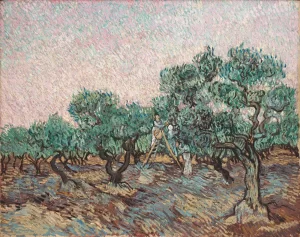
Olive Picking painted by Vincent van Gogh in 1889. Credit: via Basil & Elise Goulandris Foundation. The painting is described as being “repeatedly and secretly trafficked, purchased, and sold in and through New York.”
Olive Picking is a painting by Vincent van Gogh. In it, he used his signature brush lines to capture women picking olives in an olive grove. Van Gogh reportedly painted the piece while recovering at St-Remy-de-Provence’s psychiatric clinic after mutilating part of his ear. The painting, said to be on view at the Basil & Elise Goulandris Foundation (BEG) in Athens, Greece, is the subject of a lawsuit recently filed in New York by the heirs of Mrs. Hedwig and Dr. Fredrick Stern, Jewish art collectors who fled Nazi Germany in 1936. Silver v. Basil and Elise Goulandris Foundation, 1:25-CV-08914-VSB-JW (S.D.N.Y.). If the heirs prevail, they may benefit from special tax rules for the benefit of victims of the Nazi regime.
This lawsuit (and a prior lawsuit filed in California) has been the subject of reporting by Graham Bowley for the New York Times and by Van Gogh expert, Martin Bailey, for the Art Newspaper (and YouTube videos by Latest Stories from the People (two videos), The Shared Voice, and Global Vision Network). In the litigation, the heirs assert that in 1956, when the Metropolitan Museum of Art (the Met) acquired Olive Picking from the Knoedler & Co. Gallery, and in 1972, when the Met sold it through the Marlborough Art Gallery, the Met had actual or constructive knowledge (i.e., the Met knew or should have known) of the cloud in title created by the Nazi’s looting of the Stern’s painting. Both the former and current lawsuits raise questions about the responsibility and due diligence of museums generally, including the Met, in provenance research; namely, did the Met turn a blind eye to facts it knew or should have known.
Contested Ownership of Van Gogh’s Olive Picking
Although the events alleged in the complaint occurred decades ago, the factual allegations are remarkably detailed. The complaint discusses the Sterns’ emigration to the U.S. after Dr. Stern lost his job and the Stern children were forced to switch to a separate school for Jewish children; then provides a history lesson on the laws and policies in Germany designed to remove Jews but keep their assets. Because the painting was declared by the Nazis to be “German cultural property”, the Sterns were not permitted to take it with them when they fled Germany in December 1936. The complaint follows the Sterns’ ownership of Olive Picking, from their purchase of it in August 1935, to its confiscation and appropriation, and the hands through which Olive Picking passed as it moved from Munich to Berlin to Paris to New York. The painting is described as being “repeatedly and secretly trafficked, purchased, and sold in and through New York.”
The Met’s Purchase and Sale
The complaint details the Met’s expertise with Van Gogh’s works and Nazi art looting; key employees had the knowledge and skills to identify the lack of clear ownership. For example, according to the complaint, at the time of the Met’s purchase of the painting, the Met’s curator of European paintings was both an expert on Van Gogh and one of the world’s foremost experts on Nazi art looting. The complaint alleges that the curator approved the Met’s 1956 purchase of Olive Picking and that the invoice for the purchase was addressed to him.
The Heirs’ Claims for Return of the Painting from BEG and Damages from BEG and the Met
The Sterns’ heirs are seeking different relief from the different defendants. From BEG, the heirs want the painting back or compensation for its lost possession; a declaratory judgment both that the heirs are the rightful owners and BEG has no rights to the property; and a constructive trust, obligating return of the painting or compensation. From all the defendants (including the Met), the heirs want damages for misappropriation and unjust enrichment.
Value of the Painting
To bring a case in a U.S. Federal District Court involving parties from different States or one State and a foreign state, the amount at issue must be at least $75,000 (28 U.S.C. 1332(a)). The complaint does not place a value on the painting but alleges damages “to be determined. . . but in excess of $75,000”. In 2023, Martin Bailey estimated that the actual value of Olive Picking was “many tens of millions of dollars.”
Tax Consequences if the Heirs Prevail
If the heirs prevail, what would their federal tax bill look like? As a general rule, taxable income includes any accession to wealth, clearly realized, unless the law explicitly excludes the income from tax. Commissioner v. Glenshaw Glass, 348 U.S. 426 (1955); I.R.C. § 61.
In 2001, Congress enacted a law to benefit victims of the Nazi regime (and their heirs) who receive restitution for assets confiscated by reason of the victim’s religion or other protected categories. The 2001 law provides that the restitution payments are excluded from taxable income. In addition, if a restitution payment is made in property, the recipient’s basis in the property is the fair market value of the property at the time of receipt (i.e. the recipient receives a “stepped-up” basis). The exclusion and stepped-up basis rules were enacted in the Economic Growth and Tax Relief Reconciliation Act of 2001 (EGTRRA), Pub. L. 107-16 § 803(a), and applied to amounts or property received on or after January 1, 2000 and tax years beginning before January 1, 2011. The year following the enactment year, Congress extended the restitution exclusion and stepped-up basis rules to all future tax years, making the exclusion and stepped-up basis rules apply to amounts or property received on or after January 1, 2000, with no end date. See section 2 of the Holocaust Restoration Tax Fairness Act of 2002, Pub. L. 107-358; IRS Publication 525.
The Sterns and their heirs have been fighting for decades for validation of their claims to ownership of Olive Picking. If they win, the victory will be even sweeter, thanks to the exclusion and stepped-up basis rules enacted by Congress and implemented by the IRS.
* * * * *
If you have questions about the taxation of donations of charitable contributions of art, please reach out to K. Tyson Law. We have decades of experience interpreting and advising about the tax law associated with charitable donations, including donations of art.
This alert should not be construed as legal advice, does not create an attorney-client relationship, and reflects the state of the law as of the date on this notice. Subsequent developments in the law can affect the conclusions in this alert.
Written by Kim Tyson and Karin Gross.