
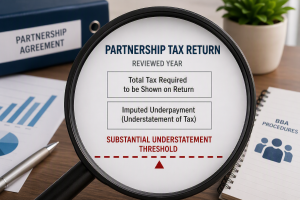
 If a taxpayer has a “substantial understatement” of income tax, the Internal Revenue Service (“IRS”) can assert a penalty. In fact, the IRS’s default procedure is that a revenue agent must obtain approval not to assert the penalty when there is a substantial understatement. IRM 20.1.5.2.1(11) and 20.1.5.4(2)d (06-03-2026). (For anyone who wants to look at the source of the penalty, it is section 6662(b)(2) and (d) of the Internal Revenue Code.)
What Makes an Understatement “Substantial” for Purposes of a Tax Penalty for Substantial Understatement of Income Tax?
For the “substantial understatement” penalty to apply, the tax understatement must be “substantial.” That definition is in section 6662(d)(1)(A) and it varies based on the type of taxpayer and whether the taxpayer claimed a deduction under section 199A.
- For most taxpayers, an understatement is substantial if it exceeds the greater of (1) 10% of the tax required to be shown on the return for the taxable year, or (2) $5,000. (See section 6662(d)(1)(A) of the Internal Revenue Code).
- A special threshold applies for corporations other than S corporations and personal holding companies. Corporate taxpayers have an understatement that is substantial if the understatement exceeds the lesser of (1) 10% of the tax required to be shown on the return (or, if greater, $10,000), or (2) $10,000,000. (See section 6662(d)(1)(B) of the Internal Revenue Code).
- For a taxpayer who claims any deduction under section 199A (the qualified business income deduction), the understatement is substantial if it exceeds the greater of (1) 5% of the tax required to be shown on the return for the taxable year (or, if greater, $10,000), or (2) $5,000. (See section 6662(d)(1)(C) of the Internal Revenue Code).
How is a Substantial Understatement Determined for a Partnership Under BBA Procedures?
Recently, the IRS released legal advice from its National Office (CCA 2026042208443600) about what is “substantial” when the taxpayer is a partnership. For 2018 and later, partnership examinations are generally conducted under rules enacted in the Bipartisan Budget Act of 2015 (BBA), Pub. L. No. 114-74, which created a new set of rules for making adjustments that relate to partnership returns, generally. BBA § 1101(a); Joint Comm. Tax’n., General Explanation of Tax Legislation Enacted in 2015. (JCS-1-16).
Under the BBA regime, the partnership is treated as an individual subject to tax for the reviewed year. (See section 6233(a)(3) of the Internal Revenue Code). A “reviewed year” is the partnership taxable year to which the item being adjusted relates (meaning the tax year being audited). (See section 6225(d)(1)). The imputed underpayment is treated as the understatement of tax for the reviewed year, and penalties are determined based on the amount of the partnership’s imputed underpayment. (See Treas. Reg. section 301.6233(a)-1(c)(2)(iv)(B)).
Is there an Example of the Calculation to Refer to?
The IRS advice refers to an example in the Internal Revenue Manual at IRM 20.1.5.21.3.2; which appears to be a typo. There is an example, however, at IRM 20.1.5.22.3.2.
Written by Kim Tyson, J.D., LL.M.
* * * * *
If you receive an IRS notice and need assistance, the team at K. Tyson Law can help. Our team has experience in tax examinations and litigation of penalties and of partnership issues. This article does not establish an attorney-client relationship and should not be construed as applying to a particular tax situation.