
Webinar on the Art of Giving
Donating art during one’s lifetime can offer meaningful tax and philanthropic benefits, but the rules governing charitable contributions are complex. With thoughtful planning and a clear understanding of IRS requirements, donors can maximize the value of their tax deductions while minimizing the risk of an audit or an unfavorable IRS determination.
Museum Exchange Co-Founder and CEO Robert Wainstein along with former IRS attorneys Karin Gross and Kim Tyson hosted a special webinar exploring the tax and compliance considerations surrounding charitable gifts of art. The session explored lifetime giving strategies, common pitfalls, and helpful resources for navigating the donation process.
After our conversation ended, the questions continued to come. A postscript of that conversation is below and answers the most common questions generated by attendees. Thank you, Robert, for the great conversation.
Deductibility Eligibility
-
-
- Does owning an artwork for less than one year before donating affect the deduction amount the donor is able to claim with the IRS?
-
Yes. If the donor of artwork held the artwork for one year or less, the donor’s deduction is generally limited to the cost to acquire it, not its current fair market value. For example, if a donor bought a painting for $10,000 in March and its fair market value is $15,000 when it is donated in November of the same year, the donor’s deduction may not exceed $10,000. If the artwork has lost value since the donor purchased it, the deduction cannot exceed the (lower) fair market value at the time of the gift. If the claimed deduction is more than $5,000, an appraisal is required regardless of whether the donor’s deduction is limited to the donor’s cost basis.
-
-
- Can a donor claim a deduction for art purchased at a charity auction?
-
Charities receiving a payment in excess of $75 for goods or services in a part-gift, part-sale transaction are required by law to provide a written statement that provides the purchaser with a good faith estimate of the value of the goods or services.
If the purchaser of art at a charity auction intentionally pays more than the charity’s estimate of value, the amount of the overpayment is treated as a charitable contribution and may be deductible. The amount of the charity’s estimate is treated as the purchaser’s cost. If the purchaser subsequently donates the art to charity, the usual rules apply. If the donation is limited to the purchaser’s basis, the purchaser may not deduct more than the charity’s estimate. If not limited to basis, the deduction is limited to fair market value.
-
-
- If a donor purchases artwork at a large discount and then donates it a year and a day later, will the donor be able claim a deduction of the fair market value?
-
The donor may generally claim a deduction for fair market value for the donation of long-term capital gain property. The price a donor recently paid may be the best evidence of fair market value. Form 8283 asks for the donor’s purchase price and purchase date, and a large gap between what the donor paid a year ago and the value claimed for the contribution may draw IRS scrutiny. To support the higher value, the appraisal should explain why the recent purchase does not reflect fair market value, such as when the donor bought it in a forced sale or from a seller who did not know its true worth.
-
-
- If a charity transfers donated art to another charity within three years of donation would a Form 8282 still need to be filed?
-
A charity’s transfer of art to another charity within three years of the original contribution counts as disposition of the art, so the first charity must file Form 8282 and give the second charity the information it needs to file if it disposes of the art within three years of the date of the donation. There may be tax consequences to the donor arising from the charity’s disposition within three years of the date of contribution.
-
-
- If a donor and donee enter into a legally binding commitment for a deaccession restriction, what impact does that have on the value of the property and how should that be reported in the appraisal or on the Form 8283?
-
The appraiser should note in the appraisal any restriction on selling or transferring the artwork and state whether the restriction affects the value and, if so, by how much. On Form 8283, Section B, Part II, the donor must disclose any restriction on the charity’s right to dispose of the donated property and attach a statement explaining the terms of the restriction.
In a 2025 case, WT Art P’ship v. Commissioner, the IRS argued that a museum’s promise not to sell a donated painting lowered its value. The Tax Court found that no binding promise existed. The court also indicated, under the facts in that case, that even a binding restriction would have had little or no effect on value.
Documentation
-
-
- Should the “received” date on Part V of Form 8283 be the countersignature date on the deed of gift or the date the artwork was physically received?
-
To be effective, a deed of gift must be signed by the donor and the donee. Generally, the date of the last of those two signatures on the deed of gift may be used as the “received” date entered by the donee on the Donee Acknowledgment of Form 8283.
-
-
- Is a deed of gift always required for a donation to a charity?
-
A deed of gift is not always required for transfers of personal property, although for donations of significant value, a deed of gift is helpful to memorialize the terms and date of the gift and the change in ownership.
-
-
- What is the difference between a deed of gift and a CWA?
-
A deed of gift memorializes the transfer of ownership from the donor to the donee.
A CWA is a “Contemporaneous Written Acknowledgment”, which is a document provided by the donee to the donor to satisfy the tax law requirement for donations of $250 or more and must: (1) identify the property that was gifted; (2) state whether the donor received goods or services in exchange for the donation; and (3) if the donor received goods or services in exchange for the donation, state the value of the goods or services received.
-
-
- Can you provide a sample CWA? Alternatively, can you provide a list of items that should be includedona CWA?
-
Sample CWA:
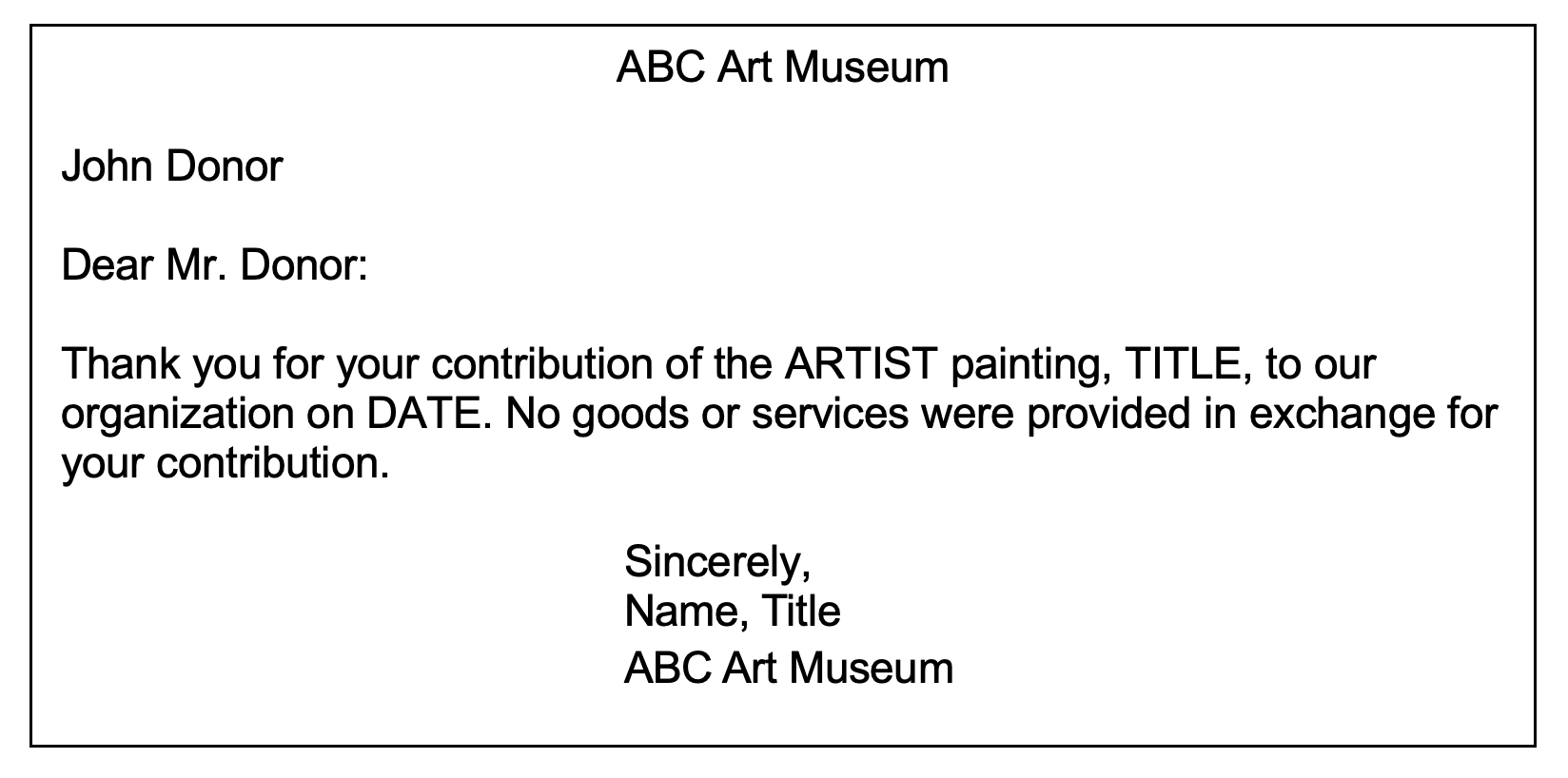
A CWA must include:
-
-
-
- The name of the donee organization
- The amount of any monetary contribution
- A description (but not FMV) of any contribution of property
- A statement that no goods or services were provided in return for the contribution, if that was the case
- If the organization did provide goods or services in return for the contribution, a description and good faith estimate of the fair market value of the goods or services
- If the organization only provided intangible religious benefits in return for the contribution, a statement to that effect.
-
-
-
-
- Does a deed of gift supersede a CWA or are both required?
-
A deed of gift does not replace a CWA. The CWA is required for any gift of $250 or more.
A deed of gift is not required for transfers of personal property, but it is good practice to use a deed of gift for donations of personal property of significant value.
Statements in a deed of gift may, if they contain the required language, be used to satisfy the CWA requirement, but the best practice is for the donor to obtain a separate CWA.
-
-
- Is it a best practice to submit the CWA with the appraisal, deed of gift, and 8283?
-
Donors should keep a copy of the CWA and the deed of gift, but attaching them to the return causes no harm, and they can answer the IRS’s first questions if a donation claimed on a return is reviewed by revenue agents. It is best practice for an appraiser to include a deed of gift with the appraisal.
-
-
- Does the CWA have to contain the words CWA?
-
No, a particular title or label is not required. What matters is the contents of acknowledgement: the charity’s name, a description of the donated item, and a statement of whether the donor received anything in return (and what the value of the good or service is if the donor did receive something in return).
-
-
- Does the donor need to provide the IRS with high resolution professional photography for artworksbeing donated?
-
Generally, no. For an individual artwork valued at $20,000 or more, the donor must provide a photograph if the IRS asks for one. It does not need to be taken by a professional. The instructions to Form 8283 state that the photograph must be of “sufficient quality and size or a high-resolution digital image to fully show the object.” This is something a modern phone camera can produce.
Appraisals
-
-
- When selecting comparable sales for a donation appraisal, is there a general guideline for how far back an appraiser can go? Can an older sale be included if it is one of the most relevant comparables?
-
Appraisals used to substantiate a charitable donation must be in accordance with generally accepted appraisal standards, which means compliance with the substance and principles of the Uniform Standards of Professional Appraisal Practice (USPAP).
If an appraiser uses an older sale as a comparable sale, the appraiser should explain why the comparable sale was chosen and adjust for changes in the market since the sale.
Categories
-
-
- Does Art Appraisal Services only review valuations of art?
-
No, IRS’s Art Appraisal Services also reviews valuation of collectibles.
-
-
- How are “collectibles”generally defined?
-
For donations, the IRS defines collectibles as coins, stamps, books, gems, jewelry, sports memorabilia, and dolls, but not art. See instructions to Form 8283, instructions for completion of line 2 of Section B.
-
-
- Is jewelry categorized as “art”?
-
Generally, no; jewelry is a “collectible” for purposes of completing line 2 of Section B of Form 8283. “Art” is defined to include paintings, sculptures, watercolors, prints, drawings, ceramics, antiques, decorative arts, textiles, carpets, silver, rare manuscripts, historical memorabilia, and other similar objects.
Written by Karin Gross, J.D., LL.M., Kim Tyson, J.D., LL.M., and Aramis Ravery

About the Panelists
Karin Gross and Kim Tyson are tax attorneys at K. Tyson Law, a boutique tax law firm advising clients on the tax aspects of charitable giving and resolving federal tax disputes. Together, they bring more than 50 years of experience at the IRS and U.S. Tax Court to provide specialized tax counsel to individuals, wealth advisors, charities, businesses, and other entities.
Karin joined K. Tyson Law after 30 years as a Special Counsel in the IRS Office of Chief Counsel. She served as the Office’s subject matter expert on the charitable contribution deduction and related appraisal requirements. In that role, she provided written guidance for the public on charitable contributions and worked on Treasury regulations governing qualified appraisals. Karin received a JD from the University of Wisconsin Law School and a graduate tax law degree from Georgetown University Law Center. She is a member of the DC Bar and a Fellow of the American College of Tax Counsel.
Kim founded K. Tyson Law after nearly 20 years as a field attorney and, ultimately, Senior Counsel and Supervisory Attorney in the IRS Office of Chief Counsel. She served as the Office’s subject matter expert on civil tax penalties. In that role, she advised and represented the IRS in tax examinations and before the IRS Independent Office of Appeals as well as in litigation before the U.S. Tax Court. She also advised revenue agents and attorneys nationwide on tax issues related to charitable giving. Earlier in her career, Kim served for 2 years as a U.S. Tax Court law clerk and practiced law as an attorney in a multinational law firm. She was recently recognized by The Best Lawyers in America® for Tax Law. Kim received a JD from the University of Baltimore School of Law and a graduate tax law degree from Georgetown University Law Center. She is a member of the North Carolina Bar and a Fellow of the American College of Tax Counsel.
Robert Wainstein is Co-Founder and CEO of Museum Exchange, the first and only digital platform for art donations. Drawing on 15 years of experience as a museum curator and art advisor, he works at the intersection of art, philanthropy, and wealth management, helping donors and institutions maximize the financial and philanthropic value of their art collections.
Robert co-founded Museum Exchange in 2020 after six years as a partner at David Moos Art Advisory, a boutique firm that works closely with private individuals to build collections of lasting significance. Previously, he held curatorial positions at the Whitney Museum of American Art in New York, MASS MoCA in North Adams, and the Art Gallery of Ontario in Toronto, where he organized numerous exhibitions of contemporary art and architecture. Robert received a BA in Art History and Economics from the University of Pennsylvania and an MA in Art History from Williams College.