


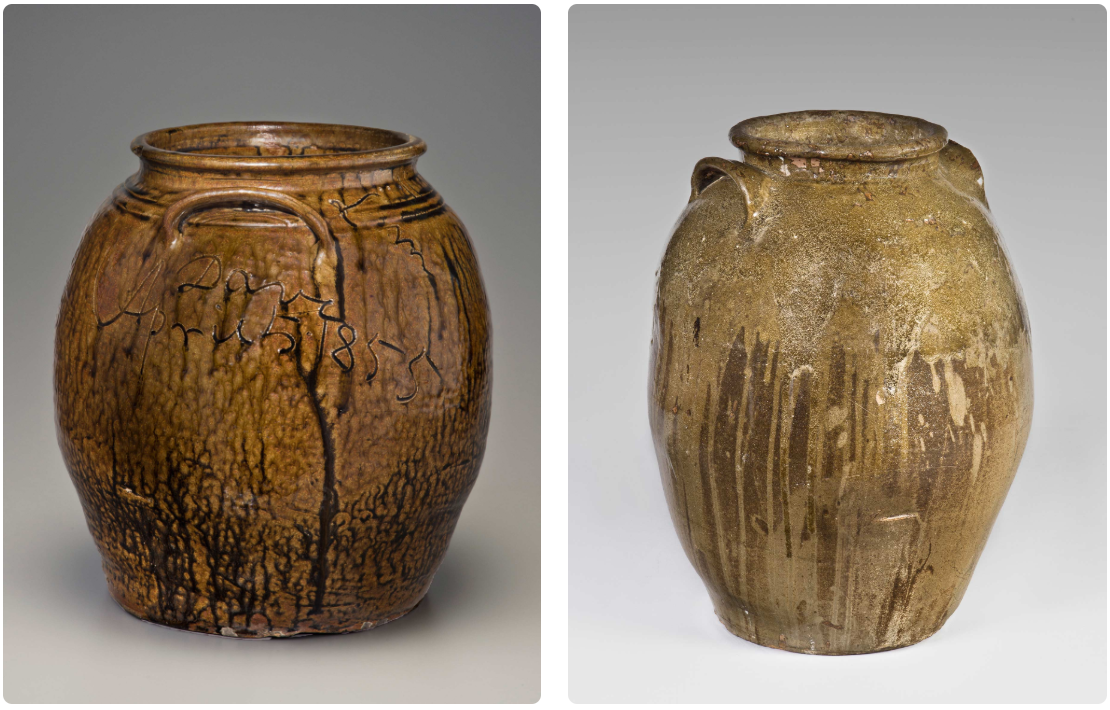
Left: David Drake (American), Jar, 1855. Alkaline-glazed stoneware, 13 in. (33.02 cm). Milwaukee Art Museum, Purchase, ethically acquired from and for the benefit of the artist’s descendants, with funding provided by a Museum donor, M2026.51.
Right: Attributed to David Drake (American), Jar, 1840–1850. Alkaline-glazed stoneware, 25 in. (63.5 cm). Milwaukee Art Museum, ethically borrowed from the artist’s descendants, to whom the work was returned by the Museum, L6.2026.1. Photos and captions from Milwaukee Art Museum Press Release.
Dave the Potter was a potter, poet, and enslaved in South Carolina in the 1800s. He made hundreds of vessels, jugs, and bottles, but he is most famous for his giant stoneware storage jars. These massive, 40-gallon vessels were among the largest produced in South Carolina before the Civil War and were used to store food.
Dave became a master artisan, creating pots that were both beautiful and useful. He taught himself to read and write, inscribing his name on many of the pots and often including poems and verses on the sides. His pots, considered significant examples of American ceramics, sell for more than $1 million.
The Descendants’ Efforts to Reclaim Dave’s Artwork
Dave’s descendants organized the Dave the Potter Legacy Trust for the benefit of Dave’s descendants and have been working since 2022 to acquire ownership of Dave’s pottery from around the country. They have reached agreements with at least four museums.
In a prior post, we discussed that the Museum of Fine Arts, Boston (MFA) held two of Dave’s pots and transferred ownership of the pots to the Dave the Potter Legacy Trust. Although the MFA had legal ownership of the pots, that ownership raised questions about rightful ownership. After the transfer from the MFA to the trust, the MFA bought one of the pots for an undisclosed amount, and the trust loaned the other pot back to the museum. Our prior post also discussed how the trust would determine its basis in each of Dave’s pieces and the legal characterization of the transfers.
Museums Begin Returning Dave’s Pottery to His Family
Recently, the trust recovered Dave’s masterpieces from the Georgia Museum of Art and the Virginia Museum of Fine Arts (VMFA). The Georgia Museum of Art transferred ownership of a much smaller, 4-gallon ceramic jar from its collection to the trust, then purchased it back. Separately, the trust loaned another one of Dave’s jars to the museum. In an article published in ARTSATL, David Odo, the former director of the Georgia Museum of Art, noted that the agreement with the trust was a small way that the museum could recognize the history of the piece — created with extraordinary skill, beauty, and utility — that Dave never could own or pass on to his family. The VMFA reached an agreement with Dave’s descendants over one of Dave’s 1840 poem-inscribed vessels. The museum returned ownership of the vessels to the descendants and will purchase for its permanent collection, in return for an authorized certificate of ethical ownership.
Milwaukee Art Museum Joins the Restitution Effort
Also, the Milwaukee Art Museum transferred two of Dave’s vessels to the trust. They had been owned by the Chipstone Foundation (Chipstone), whose mission includes stimulating research and education in the decorative arts. Chipstone had loaned the pots to the Milwaukee Art Museum, but after the MFA transferred its pots to the Dave the Potter Legacy Trust, Chipstone began to consider options for transferring ownership of its pots to the trust. According to Jon Prown, the Executive Director and Chief Curator of Chipstone, there was no obvious legal framework for the transfer. In September, Chipstone donated the pots to the Milwaukee Art Museum, where they had been on display.
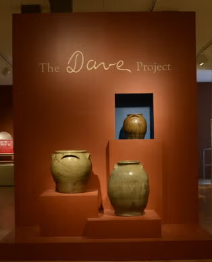
Photo of The Dave Project installation by Jim Wildeman for Chipstone Foundation.
For decades, Chipstone partnered with the Milwaukee Art Museum to share innovative installations with a strong emphasis on historical African American material culture. Chipstone created The Dave Project, an educational initiative that includes the Dave Installation at the museum; a short documentary, Dave the Potter and other videos; a case study about Dave, Outlasting Denial; and a curriculum guide featuring Jar, 1855, and Jar, 1840-1850.
In an October 6th press release, the Milwaukee Art Museum announced that it transferred ownership of two of Dave’s vessels to the trust, after which it purchased one, and the trust loaned the other to the museum. The vessels from Chipstone continue to be displayed at the museum.
The press release quotes Dave’s fourth great grandson, Yaba Baker:
For our family, this agreement is about more than ownership of these two vessels. It is about recognizing David Drake as our ancestor whose voice, expertise, and creativity have endured for over 175 years.
We are grateful to the Milwaukee Art Museum for their partnership and ongoing stewardship of Dave’s work. We believe it is important that people continue to be inspired by his unwavering perseverance in life and the brilliance that it took to create these amazing pieces of art. By keeping both on view in Milwaukee, we know that his legacy and lineage will remain accessible to the public for years to come.
George Fatheree III, attorney and advisor to Dave’s descendants, thanked Dr. Kim Sajet, the Donna and Donald Baumgartner Director of the Milwaukee Art Museum, and her team, as well as Chipstone for their roles in making restitution possible. According to Fatheree:
Museums have historically embraced principles of ethical restitution for Jewish and indigenous communities and foreign governments, but these principles have not been applied to artwork created by enslaved Americans until David Drake: I am honored to advocate on behalf of Mr. Drake’s descendants in our ongoing effort to reclaim their ancestor’s prolific work and legacy and we invite other museums in possession of Mr. Drake’s artwork to engage with the family in this process as we move towards justice.
Sources
Jori Finkel, Milwaukee Museum Returns Pots by Enslaved Artist David Drake to Family, New York Times (Sept. 26, 2026).
Sonja Anderson, The Milwaukee Art Museum Just Returned Two Ceramics Made by Enslaved Potter David Drake to His Descendants, Smithsonian Magazine (Sept. 29, 2026).
Anya Sesay, Milwaukee Art Museum returns enslaved potter’s vessels to descendants, Milwaukee Journal Sentinel (Sept. 27, 2026).
Michael Horne, How Two Clay Pots In Milwaukee Became A Test Case For Restitution For Enslaved Artists, Urban Milwaukee (Sept. 29, 2026).
Lyndsey Parker, Milwaukee Art Museum Transfers Enslaved Potter’s Vessels, Buys One Back, hoodline Milwaukee (Sept. 27, 2026).
Andrew Alexander, Georgia Museum of Art sets new precedent for restitution to enslaved artist’s heirs, Arts ATL (Jul. 23, 2026).
Angel Saunders, Milwaukee Art Museum returns 2 ceramics to descendants of enslaved potter David Drake, MSN.com People (Sept. 30, 2026).
Press Release: VMFA Restores Ownership of Work by Enslaved Artist David Drake – Virginia Museum of Fine Arts, (Sept. 30, 2026).
# # #
If you have questions about the tax deduction for donations of art, please contact the attorneys at K. Tyson Law. We have decades of experience interpreting and advising about the tax law associated with charitable donations, including donations of art.