
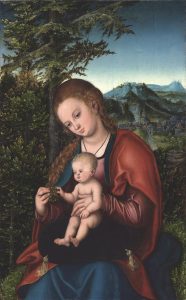
Madonna and Child in a Landscape
On February 18th, the Center for Art Law is sponsoring a lecture by Deborah Gerhard, the Paul B. Eaton Distinguished Professor of Law at UNC School of Law. The topic is the “Madonna and Child in a Landscape,” the famous (and infamous) piece that has adorned the North Carolina Museum of Art for decades. The original owner was an Austrian industrialist who fled Nazi-occupied Vienna in 1938, leaving his art collection with his niece. The Nazis allegedly confiscated the collection. In 1999, his heirs detailed this history to the NCMA. NCMA’s then-curator described the history as adding an “eerie veneer to the painting.” NCMA offered the painting back to the heirs, who reciprocated by selling the painting to NCMA at a price substantially below fair market value (i.e., a bargain sale).
A bargain sale is generally a sale of property for less than the property’s fair market value. If a bargain sale by a U.S. taxpayer is to a charity, the seller/donor can generally deduct the non-sale portion as a charitable donation. Reg. 1.170A-4(c)(2)(ii). The seller/donor must allocate her basis in the property between the sale and the donation by multiplying the adjusted basis of the entire property by the ratio of the amount realized to the FMV. IRC § 1011(b); Reg. § 1.1011-2(a) & (b). If the basis allocable to the sale is less than the amount realized, the seller/donor recognizes gain to that extent. Reg. § 1.1011-2(a). (For conservation easements, see Reg. 1.170A-14(h)(3)(iii)). Also, no deduction is allowed for contributions/bargain sales to a foreign charity (with limited exceptions for Israeli, Canadian, or Mexican charities, under special treaty-based rules). See IRS Pub. 526.
Valuation is the most common issue with bargain sales. Other issues include describing the benefits in the contemporaneous written acknowledgement, receiving a qualified appraisal and retaining control of the property. See, e.g., Browning v. Commissioner, 109 T.C. 303 (1997); Barney v. Commissioner, T.C. Memo. 2025-133; Leo v. Commissioner, T.C. Memo. 2025-9; Braen v. Commissioner, T.C. Memo. 2023-85; Boone Operations Co., L.L.C. v. Commissioner, T.C. Memo. 2013-101; Cohan v. Commissioner, T.C. Memo. 2012-8. For art valuation cases, see WT Art Partnership LP v. Commissioner, T.C. Memo. 2025-30 (ancient Chinese painting); Estate of Kollsman v. Commissioner, T.C. Memo. 2017-40, aff’d, 777 Fed. Appx. 870 (9th Cir. 2019) (paintings by Brueghel); Estate of Elkins v. Commissioner, 767 F.3d 443 (5th Cir. 2014), aff’d in part, rev’g in part, and render, 140 T.C. 86 (2013) (fractional ownership of contemporary art (Picasso, Pollack, Cezanne, and others)).
The history of ownership increases the intrigue associated with the “Madonna and Child in a Landscape.” Kudos to NCMA for attempting to right the cloud in title. Kudos to the heirs for recognizing NCMA’s efforts to make things right without expensive litigation. Professor Gerhard’s lecture should be fascinating.
Article reposted from NCBarBlog, written by Kim Tyson. Link to original article here.